




Call for Papers for the Special Issue of Policy Futures in Education (SAGE)
22/09/2026
Share


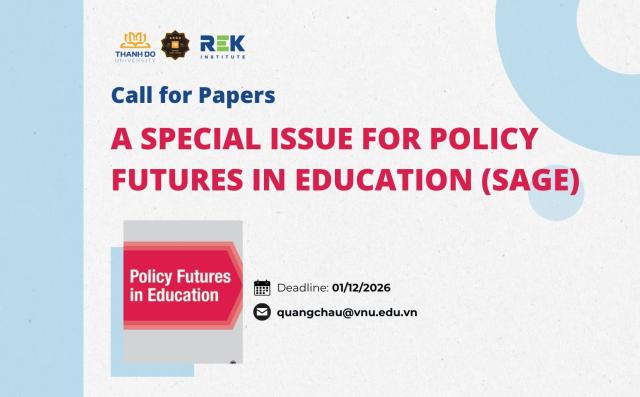
The journal Policy Futures in Education (SAGE) has recently announced a Call for Papers for the Special Issue entitled “Navigating boundaries in Higher Education: Privatisation, internationalisation and graduate employability.” Dr Hiep-Hung Pham of Thanh Do University is one of the three guest editors coordinating this Special Issue.
Policy Futures in Education, ISSN: 1478-2103, IF: 2.1, Scopus Q2
Introduction and Background
Higher education systems worldwide are being reshaped by the expansion of private provision, deepening internationalisation, and increasing policy attention to graduate employability. Although these three processes have often been examined separately, they are increasingly governed by classification systems and metric-based frameworks. Categories such as public and private institutions, domestic and international providers, accredited and non-accredited programmes, or national and foreign qualifications play important roles in resource allocation, educational provision, quality assurance, and the establishment of legitimacy.
However, contemporary higher education increasingly extends beyond these relatively rigid classificatory boundaries. The emergence of joint universities, international branch campuses, transnational education programmes, and hybrid organisational forms demonstrates that boundaries between public and private, domestic and international, or different types of qualifications are not always clear-cut. These boundaries often become spaces where higher education institutions, academic staff, students, policymakers, and employers interpret, adapt to, negotiate, and sometimes transform existing classifications.
From this perspective, the Special Issue aims to illuminate the relationship between privatisation, internationalisation, and graduate employability through the lens of policy-created boundaries and classification systems. Alongside perspectives on classification, boundary work, hybridity, institutional logics, and public-private relations, the Special Issue also encourages the application of emerging concepts, such as Harms’ (2011) concept of social edginess, to examine how actors strategically operate within and across categories created by policy systems that cannot fully capture the complexity of higher education realities.
Scope and Themes
The Special Issue welcomes papers that analyse how privatisation, internationalisation, and graduate employability are shaped by boundaries and classification systems embedded in higher education policy. Contributions may adopt theoretical, empirical, or policy-oriented perspectives and may employ diverse methodological approaches, including comparative research, mixed-methods research, policy analysis, case studies, institutional ethnography, and qualitative or quantitative methods.
Suggested themes include:
1. Privatisation and the changing boundaries of higher education
- Public-private boundaries in higher education policy and institutional governance;
- Funding, regulation, and accountability across public and private sectors;
- Marketisation, competition, and institutional differentiation;
- New hybrid organisational forms and their policy implications.
2. Internationalisation and cross-border higher education
- International branch campuses and joint or binational universities;
- Transnational education and cross-border programme delivery;
- Cross-border quality assurance and accreditation;
- International student and academic mobilities across multiple policy regimes.
3. Graduate employability across classification boundaries
- Qualification recognition, credit transfer, and equivalency across jurisdictions;
- The labour market value of international credentials, international learning experiences, and returnee qualifications;
- Skills, competencies, and graduate transitions in increasingly internationalised systems;
- Rankings, prestige, and employability outcomes.
4. Classification, boundary work and policy design
- The role of classification systems in shaping institutional behaviour;
- Rankings, accreditation, and quality assurance as policy instruments;
- Policy ambiguities, unintended consequences, and regulatory gaps;
- How actors navigate multiple and overlapping classification systems;
- Theoretical and methodological approaches to studying boundaries, hybridity, and classification in higher education.
5. Equity, inclusion and uneven consequences
- Differential impacts of privatisation and internationalisation on students and graduates;
- Social stratification, access, and opportunities across institutional sectors;
- Recognition and legitimacy of qualifications among marginalised groups;
- Regional, national, and global inequalities in higher education and labour markets.
The Guest Editors particularly welcome studies focusing on Asia and the Global South, where the rapid expansion of private higher education, deepening internationalisation, and the adoption of metric-based governance regimes-particularly accreditation systems and league tables-create dynamic contexts for examining boundary processes in higher education.
Abstract Submission Guidelines
Interested authors should submit an abstract of 400-500 words to Dr Quang Chau at quangchau@vnu.edu.vn by 1 December 2026.
The abstract should include:
- Proposed title;
- Author name(s), affiliation(s), and contact details;
- A brief academic biography of each author;
- Theoretical foundation or conceptual framework and research methodology;
- Key or anticipated findings;
- Contribution of the paper to the themes of the Special Issue;
- Key references.
(Priority will be given to papers based on empirical research.)
All manuscripts must follow the author guidelines of Policy Futures in Education and will undergo the journal’s standard double-anonymous peer review process.
Tentative Timeline
- Abstract submission deadline: 1 December 2026
- Abstract result announcement: 15 January 2027
- Full manuscript submission deadline: 15 May 2027
- Peer review and revisions: June - November 2027
- Final decision by guest editors: December 2027
- Expected publication: January - February 2028
The Special Issue is coordinated by:
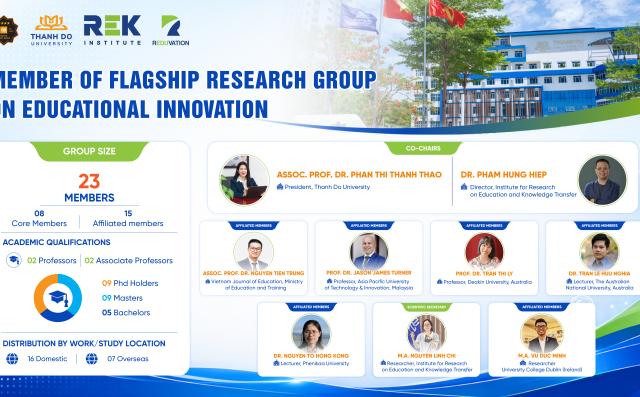
- Dr Quang Chau - University of Education, Vietnam National University Hanoi, Vietnam; Lead Guest Editor.
- Professor Ly Thi Tran - Deakin University, Australia.
- Dr Hiep-Hung Pham - REK Institution for Research on Education and Knowledge Transfer, Thanh Do University, Vietnam
For further details, please refer to the official Call for Papers here
Note: The SAGE online platform may currently restrict or prevent access from some locations in Vietnam. In case of access difficulties, prospective authors may consult the attached Call for Papers document directly.
Thanh Do University
Address: Km15, National Highway 32, Hoai Duc, Hanoi, Vietnam
Hotline: (+84) 934 078 668 - (+84) 243 386 1601
Website: https://thanhdo.edu.vn/
Fanpage: https://www.facebook.com/truongdaihocthanhdo
Recent news